by Shawn Lamb
Like many who are historical fiction fans, there is one period in history that captures attention over others. For me, it is the 17th century and catapulted by the classic The Three Musketeers by Alexandre Dumas. While other teenage girls swooned over Mr. Darcy, I wanted to fight beside D’Artangan. Eventually, I did take up fencing and competed with an eye toward the 1984 Olympics in Los Angeles.
But when I began writing my own musketeer story at age 16, my research took me down a different path. In Dumas’ classic, Richelieu is the main antagonist to the musketeers, yet the entire story came from a Catholic slant. So who where these Huguenots at La Rochelle? And why did Richelieu want to destroy them?
Absent from Dumas’ story and little mentioned in history, I stumbled upon a most
fascinating and key figure to the Huguenots – in fact to all of Protestantism during this time– Henri de Rohan.
Henri was the second son of the Viscomte de Rohan and born August 21, 1579. The family was considered a dynasty in France and he was cousin to Henry of Narrave, later King Henry VI of France. The Rohan family was well connected throughout Europe.
He began his military career at the age of sixteen and quickly distinguished himself in battle and strategy. Queen Elizabeth I called him her personal knight and he was named Godfather to Charles I. In 1603, Rohan was made a peer and given the title duke by Henry VI. Two years later he married Duc de Sully’s daughter and solidified his prominence among the French nobility.
Yet unlike many noblemen of his day, Rohan remained stubbornly loyal to his faith,
friends and family. Even when Henry VI renounced the Protestant faith and embraced
Catholicism, Rohan didn’t turn on him like others, who eventually assassinated the king for his betrayal. Instead, Rohan supported Henry’s young son, Louis XIII, with his military prowess and counsel. In turn, Louis respected and even held affection for his father’s friend and cousin. It wasn’t until persecution of the Huguenots grew dangerous that Rohan turned his industry to defending his faith and raise armed rebellion. But he directed his attacks toward the Catholic Church and Richelieu, not Louis.
Conflict between the French Catholics and Protestants was a war, within a war. All of Europe was in upheaval whether vying for power, expanding their holdings or attempting to put down the rising Protestant religion. Rohan’s influence spread far and wide due to his personal intrigue more than his family’s reputation. He was among the few who couldn’t be bought, cajoled, threatened or coerced. In this attribute lay his greatest asset and the one factor that made kings recoil and Cardinals to tread lightly.
Joined with his younger brother, Benjamin, Rohan led the fight of the Huguenots against total annihilation. His strength and fortitude kept the struggle alive even after humiliating defeats and terrible loses gained under Henry VI and the Edict of Nantes. Rohan held so much sway that a single act changed the course of the entire Huguenot population in France.
So my musketeer turned from of imitating Dumas to The Huguenot Sword, a novel highlighting the desperate struggle of one faith to survive. The dangers they faced in public for being different, the personal sacrifices of dividing families and eventually, the harrowing siege of La Rochelle, where the fate of all hung in the balance.
Website
Amazon
Barnes & Noble
Blog
Facebook
Twitter
Beginning her writing career in television, Shawn wrote for Filmation Studio’s series BraveStarr. She won several screenwriting awards including a Certificate of Merit from the American Association of Screenwriters. Recently she became a winner in The Authors Show contest 50 Great Writers You Should Be Reading for 2011. She currently lives in Nashville with her husband Rob and their daughter, Briana.
For lovers of English history and historical fiction
Indulge Your Inner Aristocrat!
Thursday, October 27, 2011
Tuesday, October 18, 2011
The Tower of London~ Part One
Below is a link to my post, The Tower of London, on English Historical Fiction Author's Blog. Someday I will actually get back to writing posts for THIS blog! I've been terribly distracted.
~~~Tower of London~ Part One~~~
Friday, September 23, 2011
English Historical Fiction Authors Blog~ Please Visit Us!
Join us at a new, multi-author blog, the English Historical Fiction Authors.
The blog will have a daily post on a topic sure to please those who love England and English history. We will also have a weekly book giveaway. I will let you check it out without further ado: Beam Me Up!
Monday, September 12, 2011
An Exciting New Event in the British Historical Fiction World
What is the big event in historical fiction coming on Sept. 23rd? It will involve many wonderful people and there will be grand and fabulous prizes, including a hefty Amazon Gift Certificate and many books! Stay tuned and I will let you know more, or leave a comment if you want to be notified.
Sunday, September 4, 2011
The Barsetshire Diaries~ Interview of Lord David Prosser
1. I am very interested in your Barsetshire Diaries. What inspired you to begin writing? And why did you choose to write what you did?
Hi Debbie. Thanks very much for your interest. I have been ill for a some time and very often housebound (chronic antisocial some say). A friend messaged to ask how my day had been and instead of saying "Boring" I set my day out as an imaginary diary. She loved it and demanded more. As an author she said it was a fun read. I chose to write what I did because the subjects are all around me and people are fun when you see their little foibles as long as you're not cruel.
2. Tell us about Barsetshire.
Barsetshire is based on a small village and the characters that occupy it using my own experience as a village dweller. All the things that happen in villages and in real life happen here with a slant towards the ridiculous. I chose to set it in Barsetshire as I didn't want to name the place I live and because it's about 140 years since The Barsetshire novels were written. After 70 years Angela Thirkell brought them up to date with her times and now 70 years later I thought I'd do the same.
3. Do you write as a person from Barsetshire?
I write as Lord of the Village in which I'm living within Barsetshire.
4. Please tell us some of the story that is revealed by the diaries to whet our appetites.
There is an occasion in the first book where I have to attend a funeral as a coffin bearer. Of the four of us, two are tall and two short. The organiser arranges the two shorter of us at the front and the two taller at the back. As we follow the Vicar the path slopes sharply down, the two of us at the front find the coffin slipping forwards towards the neck of the vicar and we have to put on speed to keep up with it. On a slippery path only mayhem can ensue.
5. Could you provide some sample diary entries?
From Book 3. More Barsetshire Diary.
Wednesday, October 27, 2010
Oscar's Gift and the Baron's Lady
I woke at 6.00 am. There was no pressure on my chest, no damp nose on my eyelids, nothing attacking my feet and yet I had woken so early. It took me a few seconds to realise that I was actually awake because I was expecting the pressure, the damp or the attack etc. I thought I must be suffering from some form of Stockholm Syndrome where the captive becomes dependant upon and would do anything for the captor. Where was the little grey blighter?
I got up, expecting at any moment to hear the miaow telling me he was hungry, but I heard nothing. I cleaned and refilled his dishes anyway and then made myself a pot of tea for a change.
By 8.00 am I had been for a shower, got dressed and woken Lady J with her usual bucket of coffee, which in order not to spill it I'd rolled along on a hostess trolley. That's not really true but her cup is so large it should be true.
There was still no sign of Oscar.
It was 8.30 am when he finally showed up. We always left a window open to accommodate his comings and goings but he was usually as regular as clockwork.
Today as he returned we heard a series of very muffled mews as though he was wearing a gag, a sound we had heard before when he had managed to wrap one of Lady J's bras round his head after falling into the laundry basket.
Anyway, we heard the sounds of his approach and then my heart dropped to my stomach as he sauntered into view and before I could take action, dropped a dead mouse at my feet. Honoured as I was, it still bothered me when he caught mice or birds when I felt he was well enough fed. Ridiculous, but I couldn't help it.
Before I was able to draw another breath, the mouse moved.
From Book 2 The Queen's Envoy.
This was fun to write as it's a prequel and gave me chance to go on adventures like a spy as well as having fun interludes at home.
Thursday, November 28, 1991
Alvin and the Chipmunks
Got up early this morning. From my window I could see the square and all the guards. There was no one in the passage outside my room so I decided to explore a bit. I showered and dressed first and then stepped out and shut my door. As I did so I noticed a red light flickering opposite and realised that there was a camera trained on my room.
Pretending I hadn't seen it I walked along the passage way in the opposite direction to the way I'd approached it last night. I soon came to two sets of stairs. One led down, presumably to the rooms I'd been in yesterday, the study and dining rooms, or maybe the kitchen was there. The other stairs went up. Faintly from up there I could hear singing of a sort. I confess the voices I could hear were more reminiscent of Alvin and the Chipmunks played at 78rpm but they were still recognisable as those of women.
I was tempted to go up but as I heard movement from below I chose to go down instead. Mehmet must have been at the bottom, shouting at Abdullah. “Find him, you fool!” I heard. “Umh, umh,umh”, was the only reply. As I appeared Mehmet stopped short, which was I suppose appropriate for someone his size.
“Good morning, Lord David”, he said, “It appears Abdullah has lost my favourite dog”, he improvised, but I knew he'd been referring to me. Turning to Abdullah he just said “Go”.
“Would you like some help to look for the little fellow?” I ventured.
6. How many books in total have you written, and could you tell us the titles?
In total so far there have been just the three books. My Barsetshire Diary, The Queen's Envoy and More Barsetshire Diary. Thee is a fourth in the planning stage where I shall have a few more adventures following the Second book.
7. Has research for the books taught you things you did not know before?
Oh yes; in book two I had to create a country for one chapter but I decided to stick to existing places after that. When I came to look at Sanliurfa as a place to visit, I was amazed not to have heard of it considering it's historical interest. Some regard it as the birthplace of the Biblical Abraham.
8. Where can we obtain a copy of your books?
The first two books are on Amazon and on Kindle. Book 3 is currently only available from Lulu.com because of a backlog on inputting books onto Amazon. Book four is only available after plying me with alcohol of a thumbscrew. I get the choice.
Lord David Prosser's Website
Sunday, August 28, 2011
Historical Articles
This post is here for entirely selfish purposes, but many of you will probably also enjoy it. I have come across wonderful historical blog posts, magazine articles, etc. over the ages (no comments, please) and I wished I had a place to save them. You can only bookmark so many sites before your bookmark list goes clear to the floor. Therefore, I am putting this post up as a place where I can put links over the ages. I invite you to bring your favorite links here, too. You can email them to me or put them in comments, and I will move them to this post. Eras will appear as links are found to match them. Thanks for your help!
Regency
George IV: The Rehabilitation of Old Naughty
A Decade a Week~ Starting in 1600 ~ by Richard Denning
Regency
George IV: The Rehabilitation of Old Naughty
A Decade a Week~ Starting in 1600 ~ by Richard Denning
Monday, August 22, 2011
Sophie Keates-Gazey on Northumberland's Castles
I have selfishly requested my friend Sophie to write a post about the area in which she lives. She had told me that the northern English coast is littered with castles, and I thought it only fair that she share them! Besides Sophie's having delighted me with her writing (a favorite poem is on her blog), it turns out that she is married to an amazing photographer. He has been willing to share some of the incredible work he has done with us all. I know that you will want to visit his site to see more.
And now, Sophie's post:
I was delighted when Debbie invited me to write a guest post for her lovely blog. Apart from being a huge compliment, it also gave me an opportunity to reflect on my immediate environment, and to appreciate it anew.
Northumberland is the northernmost county in England, having a border with Scotland and a beautiful, spacious, sandy stretch of North Sea coastline. It is one of the largest counties in England, but one of the most sparsely populated, due mainly to much of its landscape being composed of rugged moorland, more suited to our hardy breeds of sheep than to human habitation!
This is a county rich in history, vulnerable over the centuries to attacks by Viking raiders from Scandinavia, and, closer to home, by clans of brutal livestock rustlers along the Scottish border, known as 'reivers'. One testament to this turbulent history is the concentration of castles on and near its coast. They are in varying states of repair, but each has a unique story to tell.
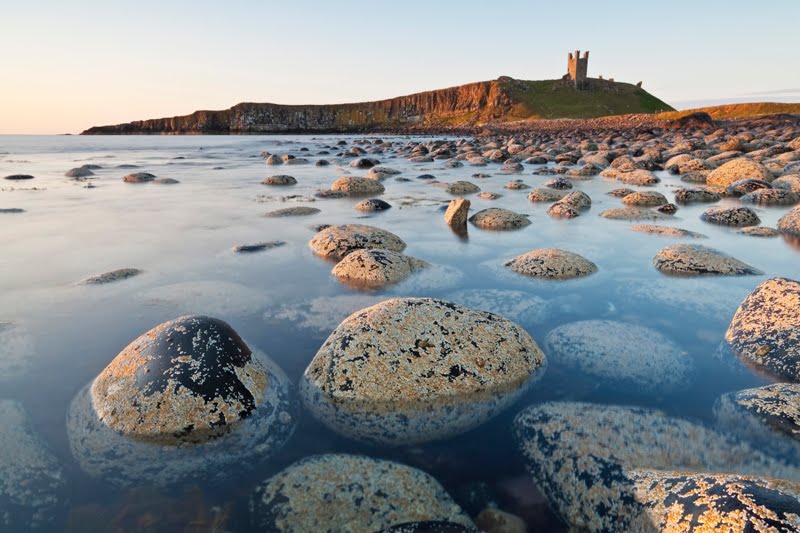
The craggy remains of Dunstanburgh Castle, on its cliff-top
Of all the castles in the area, Dunstanburgh Castle is the least well-preserved, and arguably the most atmospheric. See it on the horizon and you can understand why it is often described as looking like a mouthful of ravaged teeth.
Dunstanburgh Castle was built as a response to regular and punishing raids from the Scots in the 14th century. Its thick walls, and its position - much of the castle sits on top of cliffs with a sheer drop to the sea - provided excellent protection from attack.
The castle actually fell into ruin centuries ago. As early as 1538, it was described as being a 'very reuynus howsse and of smalle strength'. As its decline continued, its stones were plundered for new building projects.
Ruined it may be, but JMW Turner celebrated Dunstanburgh in watercolour, and today it stands noble and romantic on a beautiful coastal walk between Craster and Embleton Bay.
Another of Northumberland's castles which withstood raids by the Scots was Bamburgh, further up the coast from Dunstanburgh. The first fortress was actually built on this site in the 6th century, though nothing now remains of it, and the existing red sandstone structure, which sits on top of a volcanic outcrop, was begun in the 11th century.
Bamburgh Castle, basking in afternoon sunlight
Bamburgh holds the dubious honour of being the first castle in England to have been breached by gunfire (during the Wars of the Roses - 1455-85), and this was the beginning of its decline. However, thanks to a series of forward-thinking owners in the 18th and 19th centuries, it was restored. It was eventually purchased by the industrialist William (later Lord) Armstrong, who completed the restoration.
The castle still belongs to the Armstrong family, and makes for an interesting
visit. Unlike Dunstanburgh, this building is intact, and the visitor can explore
finely-decorated state rooms with their ornate furniture, tapestries and paintings, as well as humbler (and perhaps more interesting) domestic rooms such as the kitchen and laundry.
Further inland, the magnificent 11th century Alnwick Castle has been the principal seat of the Dukes of Northumberland since 1309. Familiar to many as Hogwarts School in the Harry Potter films, it is still very much a family home. Walk into the beautiful library, for instance, and there are family photographs on the occasional tables, along with much of the paraphernalia you would expect in a room which is regularly used and enjoyed.
The majestic Alnwick Castle, from across the River Aln
Alnwick Castle is warm and inviting, and it really is possible to imagine living here, in contrast with many other castles and stately homes, which can feel big, remote, intimidating and far from homely.
But for situation, romance and cosiness, the prize must surely go to Lindisfarne Castle, the most northerly of those featured here, and not far from the Scottish border at Berwick-upon-Tweed.
Lindisfarne Castle, perched on its rocky outcrop
Lindisfarne (also known as Holy Island) is connected to the mainland by a causeway which is only accessible twice a day, at low tide. And disaster awaits anyone silly enough to ignore the (large, graphic, unmissable...) warning signs at its entrance: every year lots of people do, and their cars are usually engulfed, and written off, when the North Sea suddenly sweeps in. (Drivers have become stranded 15 times so far in 2011, and a staggering 180 times since 2000, at massive expense to the rescue services.)
Lindisfarne Causeway, complete with rescue hut!
Anyway, to the Castle. It was built in 1542, on a massive rocky outcrop, giving it the perfect position for defending the surrounding harbour. In 1902, the Castle was acquired by Edward Hudson, a former editor of Country Life magazine, who employed Sir Edwin Lutyens to undertake a programme of restoration and improvement.
And what improvements! Hefty wooden roof-beams and solid stone archways support the ceilings of herring-bone patterned, brick-floored corridors; and the beautiful windows, many of them containing pieces of stained glass in their neo-gothic tracery, look out over the North Sea, or down over the charming walled garden, planned by legendary plantswoman Gertrude Jekyll.
This is a fairy tale castle if ever there was one, and it is even possible to get
married here. The small rooms, many of them with vaulted ceilings, are full of intimate decoration and design in the Arts and Crafts style, and seem to summon the ghosts of ancient knights on white chargers, and the damsels awaiting their arrival.
Here, as at all the castles along this coast, a sense of individuals' lives and changing fortunes is as tangible as the very fabric of the buildings themselves.
For the visitor, the castles along Northumberland's coast offer varied and atmospheric architecture, and stunning surroundings. And if you listen carefully, the very stones will whisper to you of centuries of history, violent destruction and beautiful, imaginative revival...
~~~~~~~~~~~~~~~~~~~~~~~~~~~~~~~~~~~~~~~~~~~~~~~~~~~~~~~~~~~~~~~~
Many thanks to both Sofie and her husband, the photographer, David Taylor.
Sophie Keates-Gazey's Blog
David Taylor's Website
See also the Country Life Magazine Website.
~~~~~~~~~~~~~~~~~~~~~~~~~~~~~~~~~~~~~~~~~~~~~~~~~~~~~~~~~~~~~~~~
And now, Sophie's post:
I was delighted when Debbie invited me to write a guest post for her lovely blog. Apart from being a huge compliment, it also gave me an opportunity to reflect on my immediate environment, and to appreciate it anew.
Northumberland is the northernmost county in England, having a border with Scotland and a beautiful, spacious, sandy stretch of North Sea coastline. It is one of the largest counties in England, but one of the most sparsely populated, due mainly to much of its landscape being composed of rugged moorland, more suited to our hardy breeds of sheep than to human habitation!
This is a county rich in history, vulnerable over the centuries to attacks by Viking raiders from Scandinavia, and, closer to home, by clans of brutal livestock rustlers along the Scottish border, known as 'reivers'. One testament to this turbulent history is the concentration of castles on and near its coast. They are in varying states of repair, but each has a unique story to tell.
The craggy remains of Dunstanburgh Castle, on its cliff-top
Of all the castles in the area, Dunstanburgh Castle is the least well-preserved, and arguably the most atmospheric. See it on the horizon and you can understand why it is often described as looking like a mouthful of ravaged teeth.
Dunstanburgh Castle was built as a response to regular and punishing raids from the Scots in the 14th century. Its thick walls, and its position - much of the castle sits on top of cliffs with a sheer drop to the sea - provided excellent protection from attack.
The castle actually fell into ruin centuries ago. As early as 1538, it was described as being a 'very reuynus howsse and of smalle strength'. As its decline continued, its stones were plundered for new building projects.
Ruined it may be, but JMW Turner celebrated Dunstanburgh in watercolour, and today it stands noble and romantic on a beautiful coastal walk between Craster and Embleton Bay.
Another of Northumberland's castles which withstood raids by the Scots was Bamburgh, further up the coast from Dunstanburgh. The first fortress was actually built on this site in the 6th century, though nothing now remains of it, and the existing red sandstone structure, which sits on top of a volcanic outcrop, was begun in the 11th century.
Bamburgh Castle, basking in afternoon sunlight
Bamburgh holds the dubious honour of being the first castle in England to have been breached by gunfire (during the Wars of the Roses - 1455-85), and this was the beginning of its decline. However, thanks to a series of forward-thinking owners in the 18th and 19th centuries, it was restored. It was eventually purchased by the industrialist William (later Lord) Armstrong, who completed the restoration.
The castle still belongs to the Armstrong family, and makes for an interesting
visit. Unlike Dunstanburgh, this building is intact, and the visitor can explore
finely-decorated state rooms with their ornate furniture, tapestries and paintings, as well as humbler (and perhaps more interesting) domestic rooms such as the kitchen and laundry.
Further inland, the magnificent 11th century Alnwick Castle has been the principal seat of the Dukes of Northumberland since 1309. Familiar to many as Hogwarts School in the Harry Potter films, it is still very much a family home. Walk into the beautiful library, for instance, and there are family photographs on the occasional tables, along with much of the paraphernalia you would expect in a room which is regularly used and enjoyed.
The majestic Alnwick Castle, from across the River Aln
Alnwick Castle is warm and inviting, and it really is possible to imagine living here, in contrast with many other castles and stately homes, which can feel big, remote, intimidating and far from homely.
But for situation, romance and cosiness, the prize must surely go to Lindisfarne Castle, the most northerly of those featured here, and not far from the Scottish border at Berwick-upon-Tweed.
Lindisfarne Castle, perched on its rocky outcrop
Lindisfarne (also known as Holy Island) is connected to the mainland by a causeway which is only accessible twice a day, at low tide. And disaster awaits anyone silly enough to ignore the (large, graphic, unmissable...) warning signs at its entrance: every year lots of people do, and their cars are usually engulfed, and written off, when the North Sea suddenly sweeps in. (Drivers have become stranded 15 times so far in 2011, and a staggering 180 times since 2000, at massive expense to the rescue services.)
Lindisfarne Causeway, complete with rescue hut!
Anyway, to the Castle. It was built in 1542, on a massive rocky outcrop, giving it the perfect position for defending the surrounding harbour. In 1902, the Castle was acquired by Edward Hudson, a former editor of Country Life magazine, who employed Sir Edwin Lutyens to undertake a programme of restoration and improvement.
And what improvements! Hefty wooden roof-beams and solid stone archways support the ceilings of herring-bone patterned, brick-floored corridors; and the beautiful windows, many of them containing pieces of stained glass in their neo-gothic tracery, look out over the North Sea, or down over the charming walled garden, planned by legendary plantswoman Gertrude Jekyll.
This is a fairy tale castle if ever there was one, and it is even possible to get
married here. The small rooms, many of them with vaulted ceilings, are full of intimate decoration and design in the Arts and Crafts style, and seem to summon the ghosts of ancient knights on white chargers, and the damsels awaiting their arrival.
Here, as at all the castles along this coast, a sense of individuals' lives and changing fortunes is as tangible as the very fabric of the buildings themselves.
For the visitor, the castles along Northumberland's coast offer varied and atmospheric architecture, and stunning surroundings. And if you listen carefully, the very stones will whisper to you of centuries of history, violent destruction and beautiful, imaginative revival...
~~~~~~~~~~~~~~~~~~~~~~~~~~~~~~~~~~~~~~~~~~~~~~~~~~~~~~~~~~~~~~~~
Many thanks to both Sofie and her husband, the photographer, David Taylor.
Sophie Keates-Gazey's Blog
David Taylor's Website
See also the Country Life Magazine Website.
~~~~~~~~~~~~~~~~~~~~~~~~~~~~~~~~~~~~~~~~~~~~~~~~~~~~~~~~~~~~~~~~
Subscribe to:
Comments (Atom)